|
|
American Revolution - The Complete History
1775-1783: The Complete History of The American Revolution
We hold these truths to be self-evident, that all men are
created equal... that they are endowed by their Creator
with certain unalienable Rights, that among these are
Life, Liberty and the pursuit of Happiness.
The struggle by which the Thirteen Colonies on the
Atlantic seaboard of North America won independence from Great Britain and
became the United States. It is also called the American War of Independence.
The "shot heard round the world" fired at Lexington
on April 19, 1775 began the war for American Independence. It ended eight and
a half years later September 3, 1783 with the Treaty
of Paris.
The Thirteen Colonies
The term used for the colonies of British North America that joined together
in the American Revolution against the mother country, adopted the Declaration
of Independence in 1776, and became the United States. They were New
Hampshire, Massachusetts, Rhode Island, Connecticut, New York, New Jersey,
Pennsylvania, Delaware, Maryland, Virginia, North Carolina, South Carolina,
and Georgia. They are also called the Thirteen Original States.
Causes and Early Troubles
By the middle of the 18th
century, differences in life, thought, and
interests had developed between the mother country and the growing colonies.
Local political institutions and practice diverged significantly from English
ways, while social customs, religious beliefs, and economic interests added to
the potential sources of conflict. The British government, like other imperial
powers in the 18th century, favored a policy of mercantilism; the Navigation
Acts were intended to regulate commerce in the British interest. These were
only loosely enforced, however, and the colonies were by and large allowed to
develop freely with little interference from England.
Conditions changed abruptly in 1763. The Treaty of Paris in that year ended
the French and Indian Wars and removed a long-standing threat to the colonies.
At the same time the ministry (1763-65) of George Grenville in Great Britain
undertook a new colonial policy intended to tighten political control over the
colonies and to make them pay for their defense and return revenue to the
mother country. The tax levied on molasses and sugar in 1764 caused some
consternation among New England merchants and makers of rum; the tax itself
was smaller than the one already on the books, but the promise of stringent
enforcement was novel and ominous.
War's Outbreak
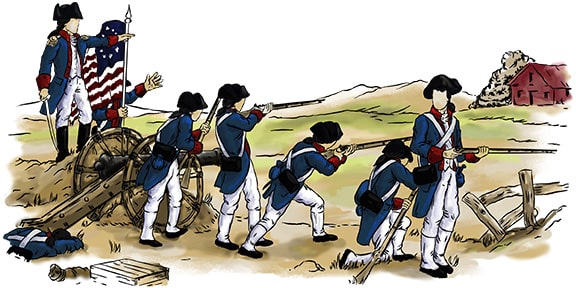
April 19, 1775, shots had been exchanged by colonials and British soldiers, men had
been killed, and a revolution had begun. On the very day (May 10, 1775) that the
Second Continental Congress met, Ethan Allen Before Congress met again the situation had changed. On the morning of and his Green Mountain Boys,
together with a force under Benedict Arnold, took
Fort Ticonderoga from the
British, and two days later Seth Warner captured Crown Point. Boston was under
British siege, and before that siege was climaxed by the costly British victory
usually called the battle of Bunker Hill (June 17, 1775) the Congress had chosen
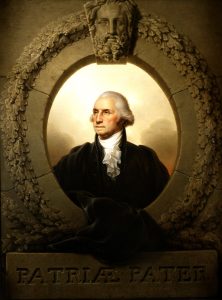
(June 15, 1775) George Washington as commander in chief of the
Continental Armed Forces.
Indecision and Declaration
The war was on in earnest. Some delegates had come to the Congress already
committed to declaring the colonies independent of Great Britain, but even many
stalwart upholders of the colonial cause were not ready to take such a step. The
lines were being more clearly drawn between the pro-British Loyalists and
colonial revolutionists. The time was one of indecision, and the division of the
people was symbolized by the split between Benjamin Franklin and his Loyalist
son, William Franklin.
Loyalists were numerous and included small farmers as well as large
landowners, royal officeholders, and members of the professions; they were to be
found in varying strength in every colony. A large part of the population was
more or less neutral, swaying to this side or that or else remaining inert in
the struggle, which was to some extent a civil war. So it was to remain to the
end.
Civil government and administration had fallen apart and had to be patched
together locally. In some places the result was bloody strife, as in the
partisan raids in the Carolinas and Georgia and the Mohawk valley massacre in
New York. Elsewhere hostility did not produce open struggles.
In Jan., 1776, Thomas Paine wrote a pamphlet,
Common Sense, which
urged the colonial cause. Its influence was tremendous, and it was read
everywhere with enthusiastic acclaim. Militarily, however, the cause did not
prosper greatly. Delegations to the Canadians had been unsuccessful, and the
Quebec campaign (1775-76) ended in disaster. The British gave up Boston in
March, 1776, but the prospects were still not good for the ill-trained, poorly
armed volunteer soldiers of the Continental Army when the Congress decided
finally to declare the independence of the Thirteen Colonies.
The Declaration of Independence is conventionally dated July 4, 1776. Drawn
up by Thomas Jefferson (with slight emendations), it was to be one of the great
historical documents of all time.
It did not, however, have any immediate positive effect.
The British under Gen. William Howe and his brother, Admiral Richard Howe,
came to New York harbor. After vain attempts to negotiate a peace, the British
forces struck. Washington lost Brooklyn Heights, retreated northward, was
defeated at Harlem Heights in Manhattan and at White Plains, and took part of
his dwindling army into New Jersey. Thomas Paine in a new pamphlet, The
Crisis, exhorted the revolutionists to courage in desperate days, and
Washington showed his increasing military skill and helped to restore colonial
spirits in the winter of 1776-77 by crossing the ice-ridden Delaware and winning
small victories over forces made up mostly of Hessian mercenaries at Trenton
(Dec. 26) and Princeton (Jan. 3).
Foreign Assistance
The warfare in the Middle Atlantic region settled almost to stagnation, but
foreign aid was finally arriving. Agents of the new nationnotably Benjamin
Franklin, Arthur Lee, Silas
Deane, and later John Adamswere striving to get
help, and in 1777 Pierre de Beaumarchais had succeeded in getting arms and
supplies sent to the colonials in time to help win the battle of Saratoga. That
victory made it easier for France to enter upon an alliance with the United
States, for which Franklin and the comte de Vergennes (the French foreign
minister) signed (1778) a treaty. Spain entered the war against Great Britain in
1779, but Spanish help did little for the United States, while French soldiers
and sailors and especially French supplies and money were of crucial importance.
Aftermath
The Treaty of Paris formally recognized the new nation in 1783, although
many questions were left unsettled. The United States was floundering through a
postwar depression and seeking not too successfully to meet its administrative
problems under the Articles of
Confederation.
The leaders in the new country were those prominent either in the council
halls or on the fields of the Revolution, and the first three Presidents after
the Constitution of the United States
was adopted were Washington, Adams, and
Jefferson. Some of the more radical
Revolutionary leaders were disappointed in the turn toward conservatism when the
Revolution was over, but liberty and democracy had been fixed as the highest
ideals of the United States.
The American Revolution had a great influence on liberal thought throughout
Europe. The struggles and successes of the youthful democracy were much in the
minds of those who brought about the French Revolution, and most assuredly later
helped to inspire revolutionists in Spain's American colonies.
|
|
|
 |
|
|